
Local SEO Agency for Small Businesses on the Eastern Shore
Three businesses show up in the map pack. Everyone else is scrolling past. We do the specific work that decides which three.
Local SEO decides which three businesses appear in the Google map pack for a search. Pufferfish Media does the specific work behind that: Google Business Profile optimization, local citations, service-area pages for the towns a business actually covers, and rank tracking. Pricing starts at $750 a month, month to month.
What's included
- Full Google Business Profile build-out: categories, services, service areas, attributes, hours, products and real job photos
- Weekly profile posts, Q&A seeding, photo uploads and monitoring for unauthorised edits
- NAP audit and citation cleanup across 80+ sources, plus duplicate listing suppression
- New citations built on the aggregators and trade directories that carry weight in Maryland
- Service-area and city pages written with detail only someone who works there would know
- LocalBusiness and Service schema tied to your real service radius
- Geo-grid rank tracking plus call and direction-request reporting from the profile
The map pack is a different algorithm
Search for a plumber in Cambridge and Google returns three businesses in a map, then the organic links well below. Those three positions take the overwhelming majority of the clicks and nearly all of the calls. They are also chosen by a different set of signals than the blue links: how close you are to the person searching, how complete and active your Google Business Profile is, how many recent reviews you have and what they say, and how consistently your business details appear across the rest of the web. Local SEO is the practice of moving those specific dials rather than generic ranking work.
Proximity is the one you cannot buy. A single profile pinned in Easton will not rank in Denton no matter how well built it is, which is why service-area businesses need real pages for the towns they actually cover. Real means detail that only somebody who works there would write: the neighbourhoods, the routes, the housing stock, the well and septic realities, the flood zones, the seasonal failure that fills your phone every March. Pages that swap one town name into a template get filtered out, and Google has been aggressive about that for a long time.
Your profile outperforms your website
For most local businesses the Google Business Profile produces more calls than the website does, and it is the asset most often left half finished. We complete every field that influences either ranking or conversion: primary and secondary categories, individual services with written descriptions, service areas, attributes, holiday hours, the business description, products, and photographs taken on real jobs rather than pulled from stock. Then it gets run as a channel instead of a directory entry: weekly posts, Q&A seeded with the questions your office answers all day, fresh photos on a schedule, and monitoring for competitor-suggested edits and category changes you did not make.
This is usually the fastest-moving part of the engagement. Clients commonly see profile-driven calls and direction requests roughly double inside ninety days, from an asset they already owned and were underusing.
Citations and the boring work that breaks ties
Your name, address and phone number are scattered across eighty-odd data sources and a good share of them are wrong: an old suite number, a tracking number that stopped forwarding two years ago, a legal name that does not match your signage, a duplicate listing splitting your reviews in half. We audit the record, correct it at the aggregators so fixes propagate downstream, suppress duplicates and build out the directories that carry actual weight in Maryland and in your trade. None of it is interesting. It is frequently the difference between third and fourth in the pack, and fourth earns nothing.
Review velocity belongs here too, because a steady flow of recent reviews mentioning the service and the town outranks a wall of five-year-old five stars. We coordinate with the review programme rather than duplicating it, so the requests going out after each job feed the same profile the local rankings depend on.
Measured on a grid, not an average
A single city-centre ranking number hides the thing you need to know. We track positions on a geographic grid across your service area, so a keyword that sits first at your shop and eleventh four miles up the highway shows up as exactly that. Reporting covers grid position by keyword and town, calls and direction requests attributed to the profile, and which service-area pages are actually producing form fills. Most clients reach top-three pack positions for their primary service and city combinations within four to nine months. Thin categories move faster. Salisbury HVAC in July moves slower.
Local SEO packages and pricing
There are three tiers. Starter, at $750 a month, is the profile-first package: full Google Business Profile build-out, 30 or more citations built and corrected, one local content piece a month and a rank-tracking dashboard. Growth, at $1,500 a month, adds weekly profile posts, four content pieces a month, location landing pages and backlink outreach, and is where most service-area businesses covering several towns end up. The third route is the bundle with reputation management at $1,000 a month, for businesses whose main constraint is review flow rather than pages.
Scope drives the number in every case, and the full breakdown of how engagements are priced is on the pricing page.
Local SEO for contractors and home service businesses
Contractors are the hardest version of this problem and the one this work suits best. You drive to the customer, so the map pack fights you on proximity in every town but your own; your jobs are seasonal; and your competitors are often ranking on nothing more than an older profile. The approach is the same across the trades and the specifics are not: roofing and exteriors, HVAC and plumbing, dumpster rental and junk removal, and self storage each have their own search behaviour, their own emergency terms and their own quiet months.
The industry pages set out how the work applies in each of those verticals, including which service and town combinations are worth building pages for and which are not.
What no local SEO looks like — and what managed looks like
Both pictures below are the same 49-point grid laid over one town, measuring where a business appears in Google Maps for one search. Neither is a client and neither is real data — they are drawn to show you how to read the measurement, because this is the same instrument we point at your business.
We measure map pack visibility on a geographic grid rather than a single ranking number. A grid places measurement points across the service area and records the business’s Google Maps position at each one, so a keyword that ranks first at the shop and twentieth four miles away shows up as exactly that. The grid size, point count, keyword and spacing are held identical between runs so the comparison stays valid.
Illustration — not client data
A listing nobody is managing
Illustration — not client data
The same listing, managed
- Top 3
- 4–10
- 11–20
- Not in the top 20
- Business location
Darker means ranked higher. Every square is labelled with its own position, so the grid is readable without relying on colour.
This is a tool, not a trophy. A grid like this is how we measure where you actually stand today. We run one on your business before any work starts, and again as changes land, so you can watch it move instead of taking our word for it. The grid size, the number of points, the keyword and the spacing stay identical between runs — change any of those and the second picture looks better for no reason at all, which is the oldest trick in this industry.
What is actually different underneath
Google Business Profile
A listing nobody is managing
Claimed once and then left. One vague category, no service area set, hours that were right two years ago.
The same listing, managed
Verified, categories chosen for how people actually search, service area drawn to the towns you really cover, every ranking field completed.
The pages behind it
A listing nobody is managing
One page listing every service in a single paragraph, and no page for any town.
The same listing, managed
A page per service and a page per town you genuinely serve, written with detail only somebody who works there would know.
Name, address, phone
A listing nobody is managing
Three different versions scattered across the web, plus an old number nobody answers.
The same listing, managed
One exact string everywhere, corrected at the aggregators so the fixes propagate downstream.
What a machine can read
A listing nobody is managing
No structured data, so Google and ChatGPT have to guess what you do, where you work and what you charge.
The same listing, managed
Schema on every page stating plainly what you sell, where you work and what it costs.
Reviews
A listing nobody is managing
Arrive at random, mostly years old, nobody answers them.
The same listing, managed
Requested after every job, answered, and recent enough to still count.
Activity
A listing nobody is managing
Nothing posted since the profile was created.
The same listing, managed
Posts, photos from live jobs and answered questions every week.
The right-hand column is the work. How it runs month to month is below.
For what that looks like page by page, see Yard Works Plus, a dumpster rental company with 20 city and county pages covering its service area, built from no prior web presence.
How it works
Claim and lock the profile
Verify ownership, remove rogue managers, set primary and secondary categories, and complete every field Google uses for ranking and conversion.
Clean the citation record
Audit 80+ sources for NAP conflicts, fix at the aggregator level, suppress duplicates that are splitting your reviews, and add the directories that matter locally.
Build the service-area pages
One page per town you genuinely serve, written with local specifics, mapped to LocalBusiness and Service schema and linked from the right places on the site.
Turn on review velocity
Post-job review requests go out on a schedule so recent, service-specific reviews keep arriving instead of arriving in bursts once a year.
Work the profile weekly
Posts, photos from live jobs, Q&A answers and edit monitoring, because an active profile beats a complete but static one.
Track the grid and adjust
Geo-grid rankings, call volume and direction requests are reviewed monthly, and the next month of content targets whichever town is lagging.
From $750/mo: 750
What map coverage actually looks like
Below are two Google Maps rank grids taken on the same day in the same market. The first is Yard Works Plus, a dumpster rental company in Easton, Maryland. The second is a competing business in that market, left unnamed.
- Average rank 1.44 across 169 measurement points
- 100% of the grid in the top 3
- 1st of 43 tracked competitors
- Keyword “dumpster rental”, Google Maps, measured 17 August 2026
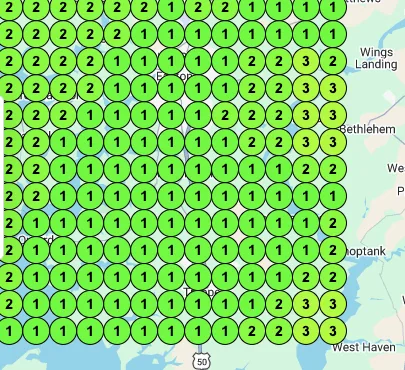
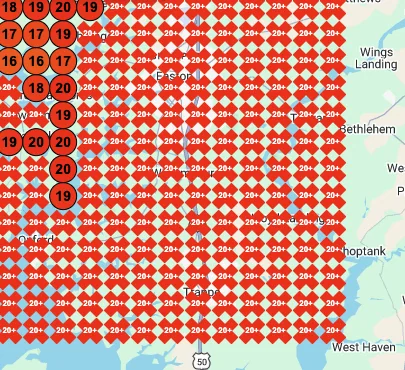
Both grids are the same 169 points, the same keyword and the same day — one business, one competitor. This is a snapshot of one market on one date, not a before-and-after and not a promise: results depend on your competition, your service area and where you are starting from.
The full grid figures, the measurement method and the honesty note behind them are on the Yard Works Plus case study, including the complete 169-point geogrid readings.
Frequently asked questions
- How do you measure whether local SEO is working?
- On a geographic grid, not a single ranking number. We place measurement points across your service area and record your Google Maps position at each one, then repeat it with the identical grid size, point count, keyword and spacing so the two runs are actually comparable. A single average can be made to improve just by shrinking the area measured, which is why the parameters are fixed up front and reported alongside the result.
- How long does local SEO take?
- Google Business Profile improvements often show inside four to eight weeks, and profile-driven calls commonly double within ninety days. Map pack positions for competitive service and city combinations usually take four to nine months, because citation corrections need time to propagate and review velocity has to build. Less competitive towns on the Eastern Shore frequently move faster than that.
- Can I rank in towns where I do not have an office?
- Yes, but not through the map pack alone. The map pack weights proximity heavily, so a profile in East New Market will struggle to rank in Elkton. The route is organic: a genuinely useful service-area page for each town, built with local detail, supported by reviews that mention that town and by citations tied to your service radius. Expect organic wins first and pack positions in nearby towns later.
- What is NAP consistency and why does it matter?
- NAP stands for name, address and phone number. Google cross-references those details across directories, data aggregators and your website to confirm a business is real and to decide which listing is authoritative. Conflicting versions, old suite numbers, or a call-tracking number published where your main line should be all weaken that confirmation. Fixing conflicts is unglamorous work that reliably moves pack rankings.
- How many reviews do I need to rank in the map pack?
- There is no threshold, only relative position. What matters is having more recent, more detailed reviews than the businesses currently in the three pack positions for your keywords. Recency and specificity carry real weight, so twenty reviews from the past six months that name the service and the town typically outperform eighty generic reviews from 2019. Steady flow beats volume.
- How much do local SEO services cost?
- Our Starter plan is $750 per month and includes Google Business Profile optimization, 30 or more local citations built, one piece of local content monthly and a rank tracking dashboard. Growth is $1,500 per month and adds weekly profile posts, four content pieces monthly, location landing pages and backlink outreach. Local SEO also bundles with reputation management at $1,000 per month.
- What is included in a local SEO package?
- Every package includes the Google Business Profile build-out, the NAP and citation record, and geo-grid rank reporting. Starter adds 30 or more citations, one local content piece a month and a tracking dashboard. Growth adds weekly profile posts, four content pieces a month, location landing pages and backlink outreach. Service-area pages, review-request scheduling and LocalBusiness schema are scoped to the towns and services you actually cover rather than sold by the page.
- Do you work with businesses outside Maryland?
- Yes. The office is in East New Market and most clients are on the Eastern Shore and the wider Delmarva Peninsula, which is where the local market knowledge is genuinely worth something. The work itself is not geographically limited: profile optimization, citations, service-area pages and grid tracking are the same anywhere. If you are outside the region, say so on the first call and we will be straight about whether local knowledge is a factor in your market.
- Do I need a physical address to do local SEO?
- You need a real address for verification, but you can hide it and operate as a service-area business, which is the right setup for contractors and mobile services. What you cannot do is use a virtual office or a mailbox address. Google actively suspends those, and losing a verified profile costs months. If you work from home, hide the address and set your service radius honestly.
Want to know what is holding you back?
Fifteen minutes with Adam. He looks at your Google listing and site live and names the two or three real problems. No pitch.